
Why Energy Recovery Ventilators (ERVs) Are Critical to Healthy, Energy-Efficient Homes
Why Energy Recovery Ventilators (ERVs) Are Critical to Healthy, Energy-Efficient Homes
Breathing Easy Indoors: Why Fresh Air Matters in Old Homes
Across North America, millions of families live in older wood-frame homes built decades ago—long before energy efficiency and indoor air quality became mainstream concerns. While these structures may hold charm and history, they often harbor a hidden problem: poor indoor air quality that quietly affects the health and comfort of their occupants.
The Hidden Health Threat Inside Old Walls
Over time, building envelopes in older houses deteriorate. Leaky roofs, unsealed windows, and condensation in wall cavities create the perfect breeding ground for mould and bacterial growth. In wood-based construction, moisture trapped behind drywall or flooring can feed fungal colonies that release spores and volatile organic compounds (VOCs).
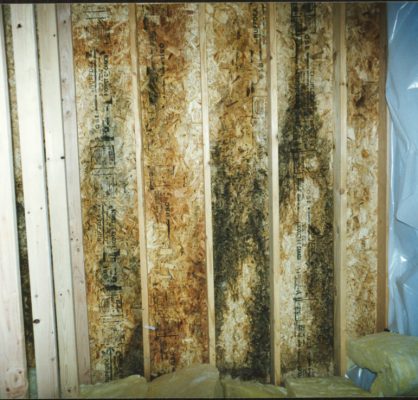
When combined with poor ventilation, these pollutants accumulate indoors. Residents may experience chronic coughing, eye irritation, fatigue, or even long-term respiratory illness. In cold-climate regions—such as much of Canada and northern U.S.—homeowners tend to keep windows closed for months to conserve heat, worsening the lack of air exchange.
Why Opening a Window Isn’t Enough
Natural infiltration—the unintended air that leaks through gaps and cracks—was once thought to provide “enough ventilation.” Modern research and testing prove otherwise. Not only is infiltration uneven and weather-dependent, but it can also pull contaminated air from attics, crawlspaces, or garages into living spaces.
That’s why the ASHRAE 62.2-2016 “Ventilation and Acceptable Indoor Air Quality in Residential Buildings” standard was established. It defines minimum air change per hour (ACH) and mechanical ventilation rates required to keep indoor air healthy. In short, it’s no longer acceptable to rely on leaks; controlled, balanced ventilation is the new baseline for occupant health.
Energy vs. Fresh Air: The ERV Solution
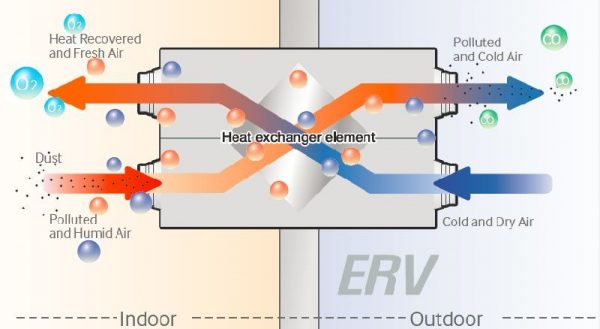
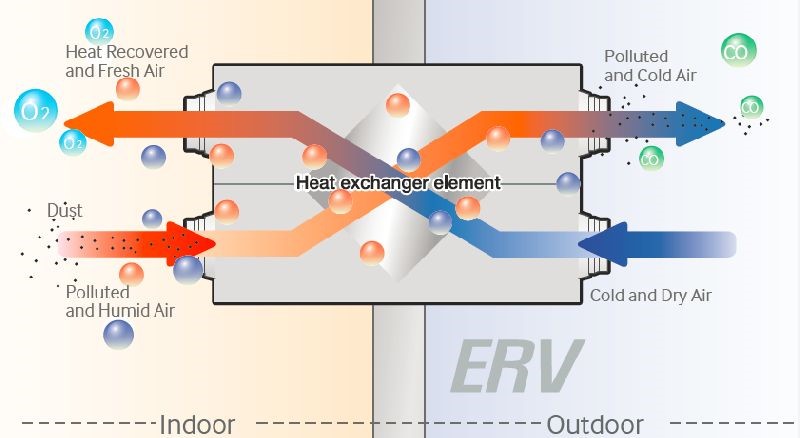
Homeowners often resist installing ventilation systems because they fear higher heating bills. But modern Energy Recovery Ventilators (ERVs) are designed to solve this exact problem. An ERV exchanges stale indoor air with filtered outdoor air while transferring heat and humidity between the two streams.
In winter, outgoing warm air pre-heats the incoming cold air—reducing the furnace’s workload. In summer, the system helps maintain comfort. The result: fresh air without energy waste.
A properly sized ERV meeting ASHRAE 62.2 typically supplies continuous fresh air around 0.35 ACH (or roughly 7.5 CFM per person + 3 CFM per 100 ft² of floor area, whichever is greater). Balanced airflow ensures contaminants are exhausted while new air is evenly distributed to bedrooms and living areas.
ASHRAE 62.2-2016 Tables (Addendum k): Filtration Factors and Credits
These official tables are often referenced when pairing whole-house ventilation with particle filtration. They map filter performance to a filtration factor (ffr) that’s used for ventilation-rate reduction credit calculations.
Table 4.3 — Filtration Factor (ffr) for Filters Tested to ASHRAE 52.2
| MERV | ffr |
| 11 | 4.3 |
| 12 | 3.0 |
| 13 | 2.1 |
| 14 | 1.8 |
| 15 | 1.7 |
| 16 | 1.6 |
Table 4.4 — Filtration Factor (ffr) for Filters Tested to AHRI 680
| Particle Size Efficiency (0.30–1.0 μm) | Particle Size Efficiency (1.0–3.0 μm) | ffr |
| 0 | 65 | 4.3 |
| 0 | 80 | 3.0 |
| 25 | 85 | 2.1 |
| 75 | 90 | 1.8 |
| 85 | 90 | 1.7 |
| 95 | 95 | 1.6 |
Table 4.5 — Filtration Factor (ffr) for Filters with a PM2.5 Efficiency Designation
| PM2.5 Efficiency | ffr |
| 35% | 4.3 |
| 50% | 3.0 |
| 70% | 2.1 |
| 85% | 1.8 |
| 90% | 1.7 |
| 95% | 1.6 |
Note: Under Addendum k, when these filtration requirements are met, a reduction (credit) against the required whole-building ventilation rate is allowed; the standard also specifies airflow distribution, filtration performance, and minimum filtered recirculation airflow (see §4.1.4).
What This Means for Old Homes
Pairing a balanced ERV with high-efficiency filtration (e.g., MERV 13+ or equivalent PM2.5 efficiency) helps you hit the fresh air exchange targets while reducing energy penalties—exactly what older, leak-prone, cold-climate homes need for healthier, more resilient living.