Volumetric vs. Foldable Modular: Choosing the Right System for Performance, Cost, and Logistics
Volumetric vs. Foldable Modular: Choosing the Right System for Performance, Cost, and Logistics
Executive summary
Two modular building archetypes dominate today’s projects: volumetric modular (fully finished 3D boxes) and foldable modular (collapsible units that ship compact and expand on site). They’re not rivals so much as tools for different constraints.
- Volumetric modular excels when you need high performance (Passive House, net-zero ready), premium fit-out, larger room sizes, and you have reliable road access and crane capacity. Factory completeness can hit 85–95%, airtightness is best-in-class, and long-term operating costs are lowest.
- Foldable modular shines when you need to reach remote sites without highways, leverage barges or small trucks, set up quickly with minimal heavy gear, control capex $/ft², and keep the option of future relocation (with re-certification).
If your program spans both urban hubs and hard-to-reach communities, combining the two is often the fastest, cheapest way to scale.
1) What they are—without the hype
Volumetric modular (3D boxes)
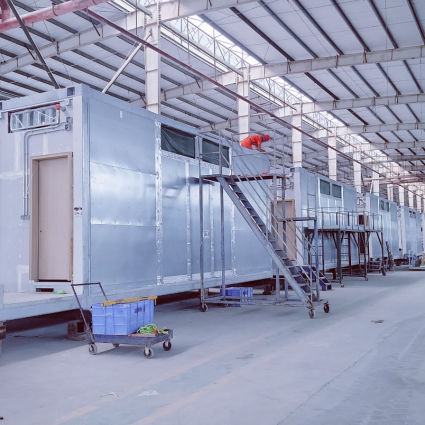
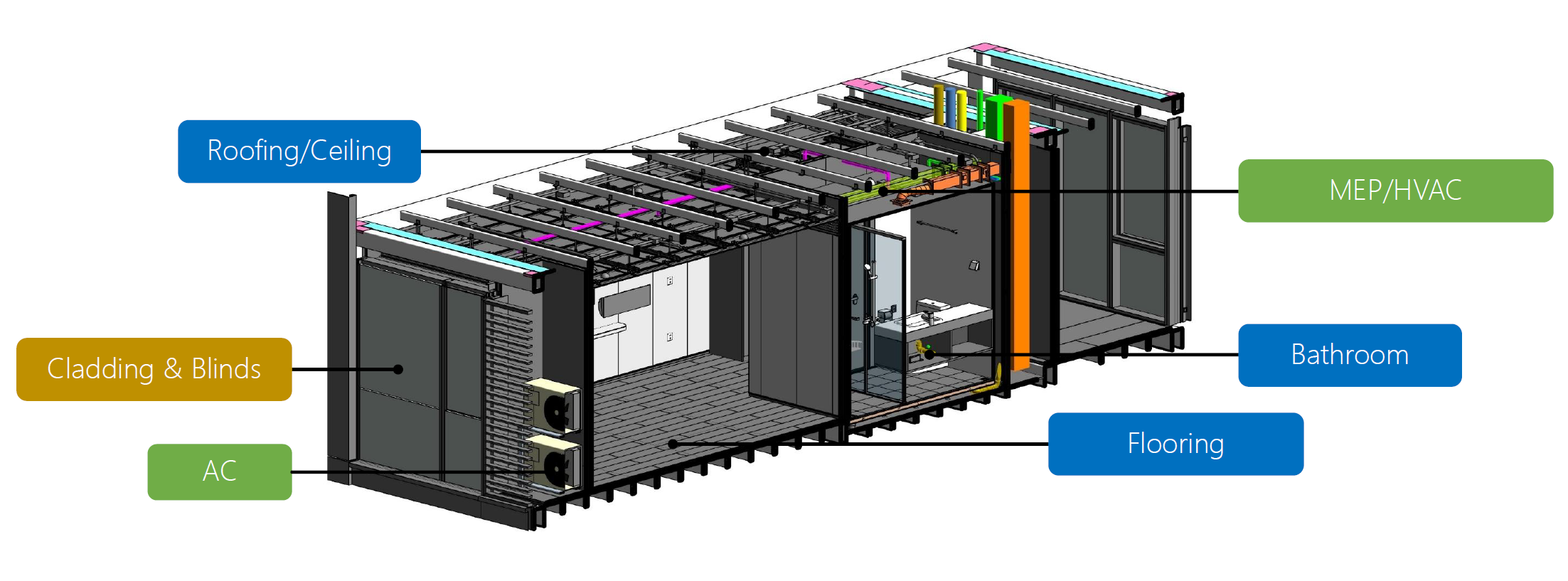
Factory builds fully enclosed modules with structure, insulation, windows, doors, interior finishes, and rough-in MEP. On site, modules are craned onto foundations, stitched structurally and MEP-wise, the façade/roof is tied in, and systems are commissioned.
Where it wins: Performance, finish quality, speed to occupancy, complex MEP, acoustic and fire ratings, multistory stacks.
Foldable modular (collapsible units)
Modules ship flat or partially collapsed to reduce volume. On site they unfold (walls/roof swing up or slide out), are locked, sealed, serviced, and finished. Many systems target permanent construction; relocation is feasible later—but you’ll need re-inspection/re-certification to re-occupy.
Where it wins: Logistics to remote/water-access sites, minimal crane reliance, rapid shelter at scale, lower $/ft².
2) High-performance envelope and energy outcomes
| Criterion | Volumetric | Foldable |
| Airtightness potential | Excellent. Factory pressure-testing per module; seam gaskets deliver continuous air barrier across stacks. | Good to fair. More field joints and moving interfaces; needs careful gasket design and on-site QA to approach volumetric levels. |
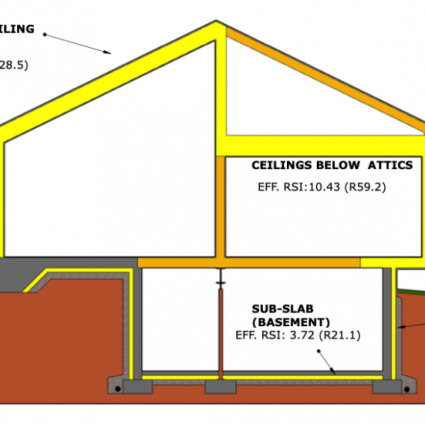
| Thermal bridges | Easier to control with continuous exterior insulation and standardized details. | More challenging at hinges, frames, and fold lines; requires thermal breaks and careful detailing. |
| Passive House / net-zero | Common; repeatable assemblies (triple glazing, ERV/HRV, high R-values) meet targets. | Possible but rarer; hinge hardware, moving joints, and thin shipping profiles can limit insulation depth unless custom designed. |
| Acoustics | Strong (STC 55+ inter-suite achievable). | Moderate; more dependent on site finishing and gasket compression. |
Takeaway: If the project mandates Passive House, net-zero, deep energy retrofits, or premium acoustics, volumetric is the straight path. Foldable can close the gap with bespoke details, but that erodes its cost/speed advantage.
3) Structure, durability, and weather resilience
Volumetric
- Primary chassis (often steel) is a single rigid frame; excellent during long-haul transport and craning.
- Predictable deflection and drift under wind/snow/seismic; good for 3–10+ stories (subject to local codes/engineering).
- Non-organic insulated assemblies pair well with heat-recovery ventilation for dry, mould-resistant interiors.
Foldable
- Engineered for compact transport; unfolded state relies on locking frames, pins, and diaphragms.
- Robust for single- to mid-rise (often 1–3 stories) where extreme wind uplift, drifting snow, or seismic demands are moderate.
- In harsh climates, detail hinge/lock points against water intrusion and thermal bridging; specify gaskets that tolerate repeated cycles.
Extreme events: For coastal storms, heavy snow belts, or high seismic, volumetric’s monolithic behavior simplifies compliance and reduces maintenance. Foldable systems can be engineered up, but you’ll spend more on detailing and inspection.
4) Logistics, access, and cranes
| Logistics factor | Volumetric | Foldable |
| Transport | Requires highway clearances; oversize loads common; best with reliable road networks. | Ships compact; more units per truck/barge; fits rough roads and small ferries; ideal for barges to remote communities. |
| On-site lift | Large mobile or tower cranes typically required; setting rate 8–20 modules/day. | Can be forklift/telehandler or small crane; fast unfolding; high daily throughput with small crew. |
| Staging | Needs laydown for full-size boxes; tight urban sites require choreography. | Small footprint during delivery; can stage many units before expanding. |
Rule of thumb: If you have highway and crane access, volumetric maximizes factory value. If not, foldable unlocks sites you couldn’t otherwise serve.
5) Speed and cost profile
- Volumetric: Fastest path to turn-key occupancy because interior is ~90% complete at the factory. Capex $/ft² higher than foldable, but fewer field hours and defects; best total cost of ownership (TCO) for long life.
- Foldable: Lowest capex $/ft² at scale; blazing fast shelter-to-dry-in. Expect more on-site finishing and a bit more QA to hit energy/IAQ goals.
Schedule math: Volumetric compresses timelines via parallel factory + foundation work, then a short, intense setting/commissioning phase. Foldable compresses transport + set, but finishing/commissioning can be a larger share of the schedule.
6) Foundations, interfaces, and finishing
Volumetric
- Prefers gridded foundations with precise anchor points; tolerance control via shims/plates.
- Envelope continuity handled with pre-taped membranes and seam gaskets; façade rails clip on quickly.
- MEP is plug-and-play; factory testing simplifies commissioning.
Foldable
- Simpler foundations (pads, rails, or slab lines) often acceptable; good for rock or permafrost regions with minimal excavation.
- Envelope continuity depends on field sealing at fold lines; train crews on gasket torque and membrane laps.
- MEP manifolds are straightforward but more connections occur on site—plan for leak tests and lockout/tagout procedures.
7) Fire, life safety, and code compliance
- Volumetric: Well-documented tested assemblies for fire-resistance (1–2 hr), smoke, and structure; easier to replicate across many units. AHJs increasingly familiar with volumetric processes.
- Foldable: Permanent-use systems can meet the same outcomes, but moving interfaces (hinges, seams) must be addressed with listed firestop systems and robust inspection. If relocated, expect re-inspection/re-certification before re-occupancy.
Pro tip: Bring the Authority Having Jurisdiction (AHJ) into a mock-up review early—especially for foldable systems—so inspection hold points and acceptance criteria are crystal clear.
8) Indoor air quality (IAQ) and moisture control
- Volumetric: Factory-installed balanced ERV/HRV, sealed ducts, and airtight modules = low CO₂, low humidity spikes, and mould-resistant assemblies.
- Foldable: Specify balanced ventilation from day one; pay extra attention at fold seams so humid indoor air doesn’t exfiltrate into cold layers. Use non-organic insulation where possible.
9) Operations, maintenance, and lifespan
| O&M dimension | Volumetric | Foldable |
| Expected lifespan | Longest; monolithic frames and robust envelopes age well. | Solid when detailed and maintained; inspect hinges/seals on cycle. |
| Maintenance | Lower: fewer field-built joints; standardized components; great documentation. | Slightly higher: periodic gasket/hinge inspection; more site-built work to maintain. |
| Relocation | Doable but not typical; requires lifting logistics. | Built-in advantage; can disassemble and re-deploy (plan for re-certification). |
10) Dollars and sense: a quick TCO lens
- Capex: Foldable usually wins ($/ft²), especially where transport dominates cost.
- Opex: Volumetric often wins (energy, call-backs, finishes, IAQ issues).
- Risk: Volumetric has fewer moving parts on site; foldable reduces transport risk and access risk.
- Program value: For permanent housing with long hold, volumetric’s durability compounds savings. For distributed, remote, or evolving needs, foldable’s logistics + relocation flexibility is hard to beat.
11) Decision matrix (paste into your RFP)
Score each criterion 1–5 (low→high importance). Multiply by how well each system scores (● poor, ●● fair, ●●● good, ●●●● very good, ●●●●● excellent).
| Criterion | Weight | Volumetric | Foldable |
| Achieve Passive/Net-Zero | □ | ●●●●● | ●●● |
| Premium finishes & acoustics | □ | ●●●●● | ●●● |
| Remote/water access logistics | □ | ●● | ●●●●● |
| Minimal heavy equipment on site | □ | ●● | ●●●● |
| Fastest dry-in at large scale | □ | ●●●● | ●●●●● |
| Lowest capex $/ft² | □ | ●●● | ●●●●● |
| Lowest lifetime O&M | □ | ●●●●● | ●●● |
| Ease of relocation (with re-cert.) | □ | ●● | ●●●●● |
| Multistory potential (4+ stories) | □ | ●●●●● | ●●● |
(Fill in weights per project and total the scores.)
12) Typical use cases that play to strengths
Volumetric best fits
- Urban/suburban rentals, student and seniors’ housing, hotels, clinics, schools
- Projects targeting Passive House, Step Code 4/5, net-zero ready
- Multi-story programs where acoustics, fire, and energy outcomes matter
Foldable best fits
- Remote communities with barge/air/ice-road access
- Disaster recovery and rapid-deployment housing that becomes permanent later
- Seasonal workforce housing with a future relocation pathway
13) Hybrid programs: the 80/20 solution
Many portfolios benefit from both:
- Use volumetric for core buildings (community hub, school wing, clinic) to anchor performance.
- Use foldable for satellite dwellings or ancillary spaces (staff units, classrooms, service blocks) that must reach remote sites cheaply and may move later.
This hybrid approach spreads factory risk, optimizes transport, and meets a wider set of policy goals.
14) Implementation playbook (condensed)
- Define constraints: performance (Passive/net-zero), site access, crane limits, schedule, budget, relocation.
- Pick system(s) via the decision matrix; engage AHJ with a compliance map (fire, structure, energy, inspections).
- Detail the envelope early: target airtightness, ERV/HRV, thermal breaks—especially at fold seams if foldable.
- Prototype and test: one first-article module for each type; pressure test, thermal scan, lift-test deflections.
- Logistics plan: routes, permits, barge schedules, staging yard; for foldable, plan unfolding choreography and gasket torque specs.
- Train local erectors: mock-ups of seam sealing/firestopping; inspection hold points; QA photo logs.
- Commission: airflow balance, leak tests, controls; capture baseline energy/IAQ metrics.
- Operate: set PM schedules; for foldable, add periodic seal/hinge inspections.
- If relocating: budget for re-inspection/re-certification and any code updates at the new jurisdiction.
15) Bottom line
- Choose volumetric when the mandate is long life, high performance, luxury finishes, or multistory—and you have road access and crane capacity.
- Choose foldable when the mandate is reach any site, deploy fast, minimize heavy equipment, lower initial cost, and keep relocation optional.
- Choose both when your housing program spans dense cities and far-flung communities.
Modular is not a monolith; it’s a toolbox. Match the tool to the constraint, design the envelope like performance depends on it (because it does), and involve your AHJ early. Do that, and you’ll get the trifecta every owner wants: on time, on budget, and built to last—no matter how you get there.