
Safe, Drinkable Water for Remote Homes—Without Chemicals
Safe, Drinkable Water for Remote Homes—Without Chemicals
Why full physical treatment (filtration + UV) is the right choice for tank-fed systems
Executive summary (for quick readers)
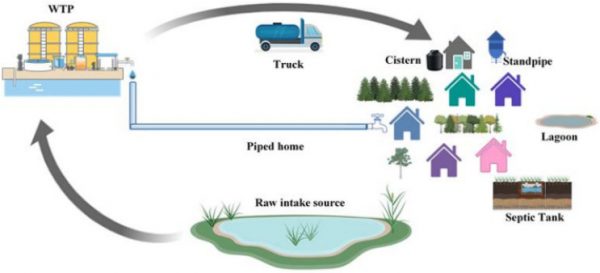
- The problem: Remote homes often depend on water delivered by tanker into a household storage tank. Between transport, filling, and storage, water can pick up sediment and microorganisms that simple strainers or point-of-use pitchers won’t reliably remove.
- The goal: Make every tap safe for drinking—consistently—without adding chemicals to the tank.
- The solution: A point-of-entry (POE) physical treatment train: sediment filtration → activated carbon → fine (≤1 µm absolute) filtration → UV disinfection.
- Why it works: Filtration physically removes particles and cysts; UV inactivates bacteria, viruses, and protozoa—with no taste or chemical changes.
- What to watch: Pre-filtration must keep turbidity low and UV transmittance high for UV to do its job. Maintainable components, winterization, and power continuity matter as much as the spec sheet.
- Bottom line: This approach is robust, scalable, culturally acceptable, and easy to operate locally—ideal for permanent housing in remote communities.
1) The context: trucked water + home tanks
In many remote communities, piped municipal water isn’t feasible. Homes are instead supplied by tank trucks that fill on-site storage tanks (often 500–2,500 L for single-family dwellings; larger for multi-family). The model is proven, but brings three recurring risks:
- Sediment & turbidity: Even source-approved water can gain particles during transport and transfer. Storage tanks accumulate sediment and biofilm over time.
- Microbial growth: Dark, ambient-temperature tanks with nutrients introduced at trace levels (e.g., dust, organic matter) can allow bacteria and microorganisms to multiply—especially if water sits.
- Intermittent quality: A single “clean” delivery doesn’t guarantee quality a week later. Water ages in the tank; hoses and fittings vary in cleanliness; fill practices vary.
These risks make “straight-to-tap” consumption unreliable—especially for infants, elders, and immunocompromised community members.
2) Why not dose the tank with chemicals?
Adding chlorine or other chemicals to household tanks can keep microbes at bay, but it comes with trade-offs communities often want to avoid:
- Taste & odor: Chlorine residuals change the taste and smell—common reasons people avoid using tap water for drinking.
- By-products: In the presence of natural organic matter, chlorination can form disinfection by-products (DBPs).
- In-tank uncertainty: Achieving and maintaining a consistent residual in a household tank with fluctuating volume and temperature is hard.
- Cultural acceptance: Many communities prefer the most natural, least intrusive approach—physical treatment that leaves water chemistry and flavor intact.
Key principle: Treat at the point of entry to the house—not inside the tank—so the household plumbing receives clean water, with no chemicals added to storage.
3) The physical treatment train that works
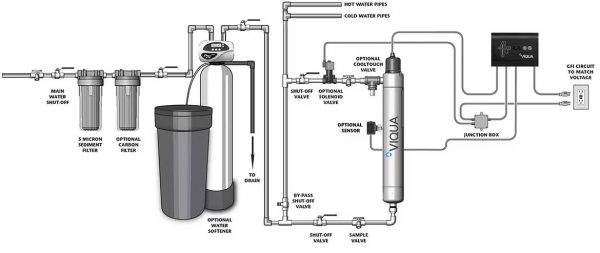
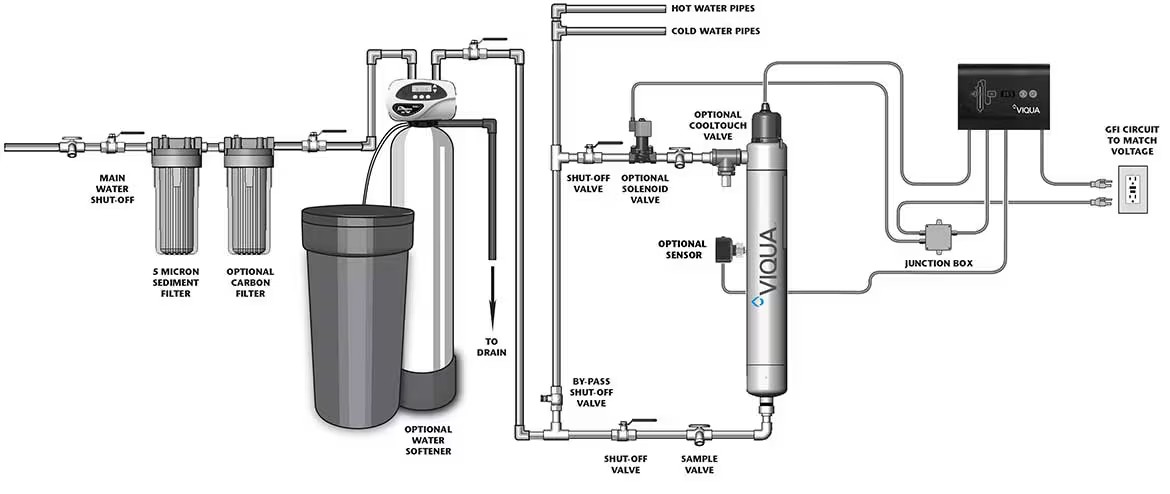
A robust point-of-entry (whole-house) system typically includes:
- Sediment prefilter (coarse)
- Purpose: Knock down sand, rust, and large particles coming from the tank.
- Typical spec: 20–50 µm washable or replaceable cartridge (or a spin-down filter for very dirty tanks).
- Placement: Immediately downstream of the tank outlet and isolation valve.
- Activated carbon block (chlorine/taste/odors + organics)
- Purpose: Improve taste/odor, adsorb organics that can shield microbes from UV, and remove trace contaminants that affect UV transmittance (UVT).
- Typical spec: 5–10 µm carbon block, sized for whole-house flow.
- Fine particulate/cyst filter (polishing)
- Purpose: Protect UV by reducing turbidity and physically removing protozoan cysts (e.g., Giardia, Cryptosporidium) which are UV-susceptible but also larger, so filtration helps.
- Typical spec:1 µm absolute (not nominal) cartridge filter to ensure reliable particle cut-off.
- UV disinfection reactor
- Purpose:Inactivate bacteria, viruses, and protozoa without changing taste or chemistry.
- Typical spec: Stainless UV chamber with proper dose (commonly ≥40 mJ/cm² at end-of-lamp-life for potable standards), UV sensor, lamp hour counter, and a fail-safe solenoid that closes when dose is inadequate or power fails.
Why prefiltration matters: UV light needs clear water to penetrate effectively. Target turbidity <1 NTU and UVT ≥75% (higher is better). Good prefiltration + carbon makes UV consistent and dependable.
4) Point-of-entry vs. point-of-use: which to choose?
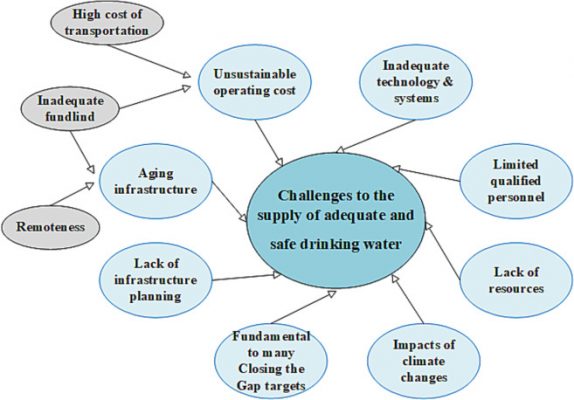
- Point-of-Entry (POE, whole-house):
- Pros: Every fixture is safe (bathroom sinks, kitchen, showers). Protects occupants from aerosolized pathogens (e.g., showers). Simplifies user behavior—no “special tap” to remember.
- Cons: Higher initial cost; must be sized for whole-house flow (8–15 gpm typical single-family).
- Point-of-Use (POU, e.g., under-sink UV + filters):
- Pros: Lower cost per fixture; easy to retrofit.
- Cons: Only those taps are safe; hygiene risks remain at other outlets.
Recommendation for permanent housing:POE whenever feasible. Consider POU as an interim solution or where budgets and electrical capacity are severely constrained.
5) Sizing & integration for remote housing
Flow rate & pressure
- Size the filter housings and UV chamber for peak household flow (8–12 gpm for a typical 3-bed/2-bath; 12–15 gpm if multiple showers may run).
- Ensure pressure drop across filters is acceptable (plan for progressive filtration to spread losses). Install pressure gauges before/after each stage to diagnose clogging.
Power & reliability
- Typical UV lamps draw 25–60 W continuously.
- Provide a small UPS or integrate into the home’s backup power so UV stays on during outages—or have the fail-safe valve lock out water until power returns.
- In extremely outage-prone areas, consider POU at kitchen as a resilience layer if POE trips off.
Cold climate details
- Locate equipment in a heated utility chase or mechanical niche.
- Heat trace the supply line from tank to house where needed.
- Include bypass and drain down to winterize if a unit is temporarily decommissioned.
Materials & certifications
- Use tanks, hoses, and components with NSF/ANSI 61 compliance (drinking-water contact).
- Choose stainless steel UV reactors with NSF/ANSI 55 Class A (or equivalent) when available—these are designed for whole-house pathogen control.
6) Operations & maintenance (O&M) that communities can own
Routine tasks
- Sediment prefilter: Inspect monthly at first; replace or clean every 3–6 months depending on tank cleanliness.
- Carbon block: Replace every 6–12 months or when chlorine taste returns/pressure drop rises.
- 1 µm absolute filter: Replace every 6–12 months (or earlier if pressure drop indicates clogging).
- UV lamp: Replace annually (UV output declines with hours even if it’s still glowing).
- Quartz sleeve: Clean during lamp changes; replace if fouled or scratched.
System checks
- Confirm the UV sensor shows acceptable dose.
- Ensure the fail-safe valve works (simulate a fault during commissioning and at annual service).
- Keep a logbook (paper or app): dates, part changes, pressure readings, any alarms.
Tank hygiene
- Sanitary tanker only; dedicated food-grade hoses with caps; no hose ends dragging on the ground.
- Backflow prevention at fill.
- Vent screens and sealed lids on the tank; minimize light intrusion.
- Annual tank inspection & cleaning: physically remove sediment and biofilm. If needed, do a one-time shock chlorination during cleaning, then thoroughly flush—this is a maintenance action, not routine dosing.
- If multiple deliveries/day are expected (e.g., multifamily), consider in-line pre-screen at fill line to keep the tank cleaner.
Water quality monitoring
- Periodic E. coli/total coliform testing at a representative tap, plus turbidity and, if possible, UVT checks annually or after any major maintenance.
- Document results for AHJ reporting and community transparency.
7) Health protection: why UV is so effective
- Broad-spectrum disinfection: UV damages microorganisms’ DNA/RNA, preventing replication.
- Protozoa coverage: Giardia and Cryptosporidium are chlorine-resistant at typical doses but are susceptible to UV, making UV especially valuable for surface-influenced sources or tanks with biofilm risk.
- No chemical footprint: UV adds no residual, no taste, no DBPs, and keeps the water’s mineral profile and pH unchanged—exactly what many communities prefer.
Key requirement: UV only works as designed when the water is clear. That’s why the sediment + carbon + 1 µm sequence is non-negotiable for tank-fed homes.
8) Community acceptance & user experience
- No taste change: People are more likely to drink tap water if it tastes like clean water—not a pool.
- Simple user message: “Any tap is safe.” POE eliminates confusion and special behaviors.
- Visible assurance: A small wall label showing the treatment steps, last service date, and next service due builds trust and encourages reporting if something looks off.
9) Costs & lifecycle (planning figures)
These are ballpark figures to guide budgeting for single-family homes; adjust for region and logistics:
- Equipment (POE): CAD $1,800–$3,500 for a quality UV reactor with monitoring + three-stage filtration, housings, gauges, and valves.
- Install: CAD $1,000–$2,500 depending on locality, freeze protection, and electrical.
- Annual O&M (parts): CAD $250–$450 (filters + lamp).
- Energy: ~220–525 kWh/year for a 25–60 W UV lamp (≈ CAD $25–$80/year, local rates vary).
For multifamily or community buildings, larger UV systems (higher flow, duty cycling, redundancy) and duplex filter manifolds add cost but reduce downtime.
For remote homes with trucked water and on-site tanks, physical treatment at the point of entry—multi-stage filtration plus UV—delivers what communities actually want: safe, reliable, great-tasting water without chemical additives. It’s technically sound, straightforward to operate, and aligns with community preferences for minimal alteration to water chemistry.
Short take: Keep the tank clean, keep the pretreatment honest, keep the UV verified—and every tap becomes a safe tap.