The Canadian Code Map for Steel Modular Buildings: What You Need to Comply, Who Owns It, and Why It Pays Off
The Canadian Code Map for Steel Modular Buildings: What You Need to Comply, Who Owns It, and Why It Pays Off
Executive summary
If you design or deliver steel volumetric modular buildings in Canada, compliance isn’t one code—it’s an ecosystem. At the factory level you’ll need CSA A277 for modular certification and, where applicable, CSA A660 for pre-engineered steel building systems. Your welding governance comes from the CWB suite (CSA W47.1 company certification, CSA W59 execution, and CSA W178.1/W178.2 inspection). Structural design must follow CSA S16 (hot-rolled steel) and CSA S136 (cold-formed steel). For services, apply CSA C22.1 (Canadian Electrical Code) and the National Plumbing Code of Canada (NPC). Fire and life safety route through the National Building Code of Canada (NBC)/National Fire Code (NFC) and key CAN/ULC fire test standards. For the modular process itself, use CSA Z250 (process for delivery) and CSA Z252 (guide to approvals). Together, these standards give you predictable quality, smoother approvals, and lower lifetime risk/cost.
1) Factory certification & modular process
CSA A277 — Factory-built modules and buildings
What it is: The Canadian baseline for certifying prefabricated buildings, modules, and panels. It covers factory quality programs and product certification so AHJs can accept modules as code-conforming.
Who owns it: The modular manufacturer (with a qualified certification body) and the owner/developer who specifies A277 labeling in contracts.
CSA Z250 — Process for delivery of permanent volumetric modular buildings
What it is: A process standard describing design, factory quality control, and approvals for permanent volumetric modular projects—think cradle-to-site workflow and roles.
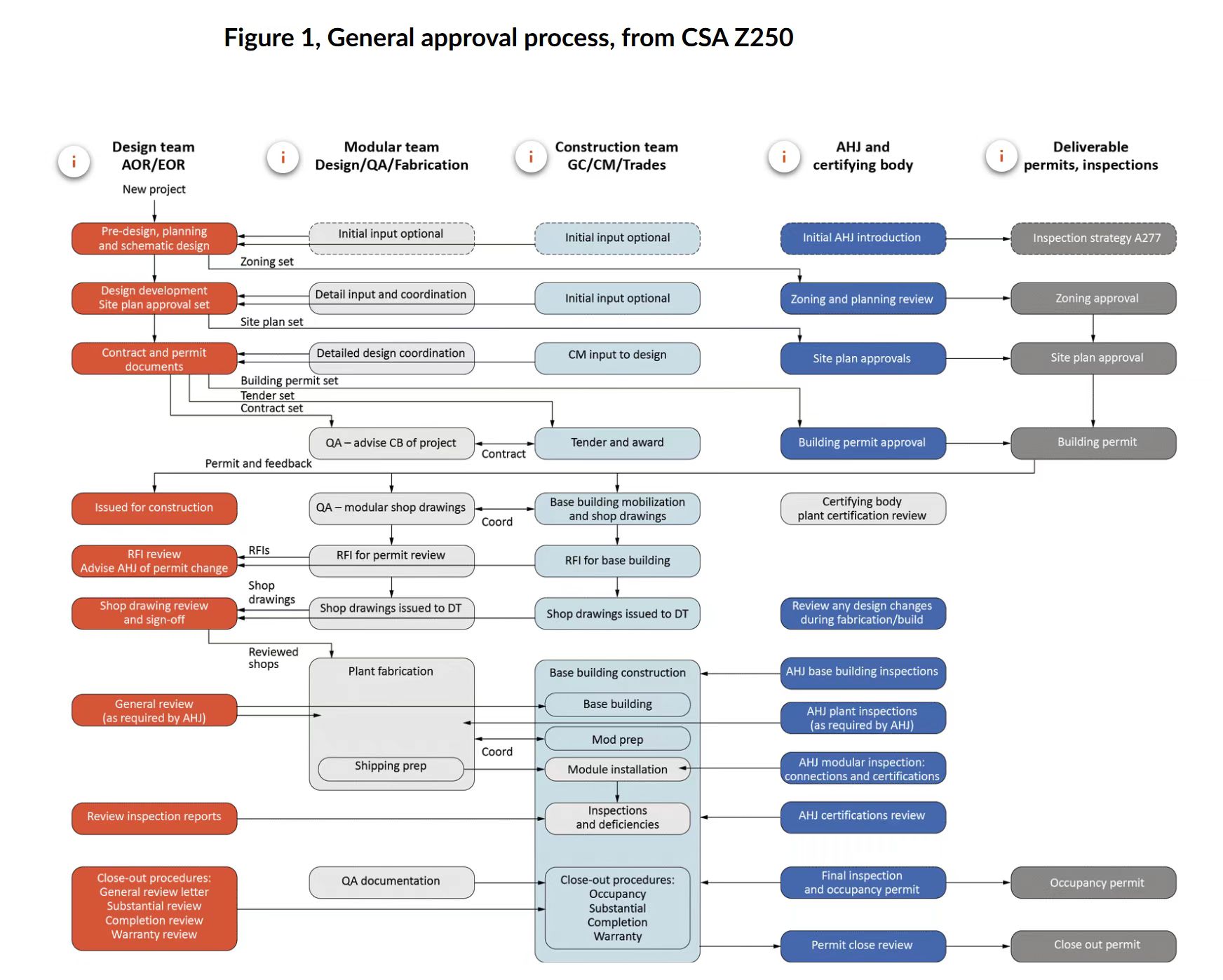
Who owns it:Design-builder/modular GC and manufacturer for planning, documentation, and interfaces.
CSA Z252 — Volumetric modular construction — Guide to compliance and approval processes
What it is: A best-practice guide for plan review, inspection, and approval of permanent modular buildings—useful to align expectations with AHJs and inspectors.
Who owns it:Authorities Having Jurisdiction (AHJs), third-party inspectors, and the project team for a smooth permitting/inspection path.
CSA A660 — Certification of manufacturers of steel buWho owns it: Design-builder/modular GC and manufacturer for planning, documentation, and interfaces.
CSA Z252 — Volumetric modular construction — Guide to compliance and approval processes
What it is: A best-practice guide for plan review, inspection, and approval of permanent modular buildings—useful to align expectations with AHJs and inspectors.
Who owns it:Authorities Having Jurisdiction (AHJs), third-party inspectors, and the project team for a smooth permitting/inspection path.
CSA A660 — Certification of manufacturers of steel building systems (when you’re delivering an SBS)
What it is: Mandatory quality certification for pre-engineered steel building systems; many jurisdictions require an A660-listed manufacturer on SBS permit submissions.
Who owns it: The SBS manufacturer providing frames/envelopes that interface with modules.
2) Welding governance (CWB framework)
CSA W47.1 — Company certification for fusion welding of steel
What it is: Requires certified welding supervisors/engineers, approved WPSs, and qualified personnel for companies welding steel. Certification is by the CWB Group.
CSA W59 — Welded steel construction (execution standard)
What it is: The execution/specification for welded steel (carbon & low-alloy): design of welded connections, consumables, workmanship, inspection, and stud welding. Your WPSs and inspection must align with W59 requirements.
CSA W178.1 / W178.2 — Certification of welding inspection organizations / inspectors
What it is: Certification requirements for welding inspection organizations (W178.1) and visual welding inspectors (W178.2), administered by CWB.
Who owns it:Fabricators, erectors, and inspection firms engaged on your project.
3) Structural design standards
CSA S16 — Design of steel structures (limit states)
Scope: Rules for design, fabrication, and erection of steel structures under limit states design, including composite action and stability provisions. Your primary standard for hot-rolled structural steel frames and connections in modular chassis, transfer systems, and craning lugs.
CSA S136 — North American spec for cold-formed steel structural members
Scope: Governs cold-formed studs, joists, tracks, and lightweight members; harmonized across Canada/US/Mexico, with Direct Strength/EWM methods and welding provisions. Essential where modules use CFS walls/floors/roof.
Tip: Many modular designs are hybrid—hot-rolled chassis to resist transport/lift and CFS for walls/trays. Apply S16 to the chassis and S136 to CFS elements, and coordinate load paths/modifiers across the two.
4) Electrical & plumbing codes (services inside the module)
CSA C22.1 — Canadian Electrical Code (CE Code), Part I
Scope: The national electrical installation standard (26th edition 2024); governs wiring methods, equipment, grounding, and inspection. Factory wiring in A277-certified modules must comply so AHJs can accept them for connection on site.
National Plumbing Code of Canada (NPC)
Scope: Technical requirements for design/installation of new plumbing systems, extensions, and repairs. Applies to in-module plumbing and site tie-ins; provinces adopt NPC (often with amendments).
5) Fire & life safety framework (national model codes + ULC tests)
- NBC (National Building Code of Canada) and NFC (National Fire Code) provide the overarching fire protection, egress, and construction rules. Modular projects must meet the same outcomes as conventional buildings (fire resistance ratings, fire separations, smoke control, etc.). (Provincial building codes mirror or amend NBC.)
- Key CAN/ULC tests you’ll reference in designs, shop drawings, and submittals:
- CAN/ULC-S101 — Fire endurance of building assemblies (used for fire-resistance ratings of floors/walls/roofs).
- CAN/ULC-S102 — Surface burning characteristics (flame spread/smoke development) for interior finishes.
- (Project-dependent) S115 firestopping, S134 exterior wall fire spread, S138 floor assemblies with combustible cores, etc., per NBC references.
Factory advantage: Repetitive, tested ULC-listed assemblies can be replicated across modules with consistent QA, simplifying compliance documentation.
6) Who is responsible for what? (Quick RACI)
| Requirement | Designer of Record | Modular Manufacturer | Fabricator / Erector | CWB-Certified Inspector | AHJ |
| A277 factory/product certification | — | R/A | — | — | C |
| Z250 modular process & roles | R/A | R | R | C | C |
| Z252 approvals/inspection guide | R | R | C | C | A |
| A660 (if using SBS) | — | R/A (SBS mfr) | — | — | C |
| W47.1 company certification | — | R (if welding in factory) | R/A | C | — |
| W59 execution of welding | C | R | R/A | C | — |
| W178.1/W178.2 inspection | — | — | C | R/A | C |
| S16/S136 structural design | R/A | C | C | C | C |
| C22.1 electrical | C | R/A | — | — | C |
| NPC plumbing | C | R/A | — | — | C |
| NBC/NFC fire & life safety | R/A | C | C | C | A |
7) Typical approval workflow that actually works
- Code path briefing with AHJ: Confirm use of A277, Z250/Z252, and any A660 scope up front; submit a high-level matrix showing which standard governs each building system.
- Design development:
- Structural: combine S16 chassis + S136 CFS walls/roofs; design craning/transport per worst-case load cases.
- Fire: select ULC-tested assemblies for required FRRs; pre-coordinate firestopping details at module seams.
- MEP: design to C22.1/NPC with standardized routings; specify listed devices and penetrations.
- Factory qualification: Verify A277 certificate, W47.1 status, WPS approvals, and inspector credentials (W178.1/W178.2).
- Shop drawings & submittals: W59 weld details, ULC designs, CE Code one-line diagrams, plumbing risers, and quality plans per Z250.
- Prototype module (first article): Inspect for S16/S136 detailing, firestop tolerances, CE Code/NPC installations, and documentation format per Z252.
- Production & QA: Hold points at structure close-up, MEP rough-in, pre-close, final; keep traceable records tied to module IDs.
- Site installation: Erection plan (W59), incoming inspections, field welds by W47.1 company, tie-ins per CE Code/NPC, and integrated testing.
- Turnover: Provide as-builts and a compliance binder: A277 label, A660 (if applicable), W47.1/W59/W178 reports, ULC listings, CE Code/NPC verification, and any NBC variances.
8) Why rigorous compliance is a business win (not just a checkbox)
- Faster AHJ reviews: A277/Z250/Z252 align factory processes with code intent, cutting RFI churn and inspection surprises.
- Lower rework risk: W47.1/W59/W178 ensure weld quality is engineered, executed, and verified—critical where modular frames see transport and craning loads before service loads.
- Predictable structure: Using S16/S136 correctly lets you optimize weight vs. stiffness and control deflection/accumulated tolerances that affect stacking and finishes.
- Repeatable life safety: NBC/NFC with ULC-tested assemblies makes FRR and interior finish compliance repeatable across hundreds of identical modules.
- Lifecycle value: CE Code/NPC-compliant factory installs reduce service calls and speed commissioning.
9) Common pitfalls (and quick fixes)
- Assuming A277 covers “everything”: It certifies factory process/product—not your structural, welding, or fire design. Pair it with S16/S136, W47.1/W59, and NBC/ULC submittals.
- Missing A660 on SBS jobs: If your scope includes a steel building system (primary frame/envelope), an A660-certified manufacturer is typically required.
- Welding without the full CWB stack: A W47.1 certificate alone isn’t enough-execution is to W59, and inspection must meet W178.
- Mixing S16/S136 rules: Clearly delineate hot-rolled vs. CFS responsibilities and load combinations to avoid gaps at interfaces.
- Late firestopping strategy: Choose S115-listed systems early for typical module seams; don’t rely on ad-hoc field fixes.
10) One-page checklist you can paste into your spec
- General: A277 factory/product certification; Z250 process; Z252 AHJ/inspection alignment.
- SBS (if used): A660 manufacturer listed.
- Structure: S16 (hot-rolled steel), S136 (Cold formed steel), craning/transport load cases signed/sealed.
- Welding: W47.1 company certification, W59 execution, W178.1 organization / W178.2 inspector credentials.
- Electrical: C22.1 compliance, labeling, and test records.
- Plumbing: NPC compliance and pressure test records.
- Fire/Life Safety: NBC/NFC compliance matrix; ULC listings (S101 FRR, S102 FSR/SDC, others as needed).
- Turnover: Compliance binder with certificates, listings, inspection reports, and as-builts tied to module IDs.
Bottom line
Treat the Canadian code landscape as a modular system itself: each standard is a component that clicks into place—factory certification (A277), process/governance (Z250/Z252), steel system quality (A660), welding quality (W47.1/W59/W178), structure (S16/S136), services (C22.1/NPC), and fire (NBC/NFC with ULC tests). Master the interfaces and you’ll deliver safer buildings, faster approvals, and lower lifetime cost—exactly what modular promises.